 Add to Chrome
 Add to Firefox
 Add to Edge
Explainable Forensics of Manipulated Segments in Untrimmed Long Videos
Jun 01, 2026
The rapid advancement of AI-driven video generation has transformed content creation, while simultaneously increasing the risk of misinformation through localized manipulations in long-form videos. Existing video forensic methods predominantly operate on short, independent clips, and thus fail to capture realistic scenarios where AI-generated content is sparsely embedded within otherwise authentic footage. To bridge this gap, we formulate the task of Temporal AI-Generated Segment Localization and Explanation, which targets authenticity detection, temporal localization, and interpretable analysis of manipulated segments in untrimmed long videos. We further introduce TASLE, a large-scale benchmark comprising 12,472 untrimmed videos with diverse manipulation patterns and rich annotation signals, including temporal boundaries, authenticity labels, and segment-level rationales. In addition, we propose MSLoc, a coarse-to-fine forensic baseline that combines a boundary-sensitive proposal generation module for efficient long-video scanning with an MLLM-based refinement module for precise boundary localization and interpretable reasoning. Experiments validate the effectiveness of the proposed baseline, highlighting the importance of segment-level explainable forensics for long-form AI-generated video analysis. Our dataset and code are publicly available at https://debby-0527.github.io/TASLE.

Spacetime Optimal-Transport Attention for Visuo-Haptic Imitation Learning of Contact-Rich Manipulation
May 19, 2026Contact-rich manipulation tasks such as tight-clearance insertion, connector mating, polishing, and surface-conforming wiping remain difficult for data-driven controllers because they couple discontinuous contact dynamics, partial observability, and strict safety constraints. No single sensing modality suffices: vision supplies global context before contact, force/torque (F/T) feedback governs interaction after contact, and proprioceptive pose provides a consistent kinematic backbone. Most prior imitation-learning policies for contact-rich tasks operate on uni- or bi-modal signals, and the few that fuse three modalities typically adopt off-the-shelf attention modules with no explicit prior on how attention mass should be distributed across task-relevant regions. We present Spacetime Optimal-Transport Attention (SO-TA), a tri-modal fusion backbone that replaces softmax-normalized patch attention by an entropy-regularized Optimal Transport (OT) alignment between force-pose-derived sub-queries and visual patches. Explicit marginal constraints act as a structured inductive bias for contact-rich tasks, encouraging conditioning-aware spatial selection that is stable across illumination, distractors, and partial occlusion. SO-TA is paired with a diffusion-based sequence policy mapping observation windows to pose-action chunks. We evaluate SO-TA on three real-robot tasks: tight peg-in-hole assembly, BCM wiring-connector insertion, and curved-surface mark erasing. With ~200 rollouts per condition, SO-TA reaches 100% success on tight peg-in-hole versus 93% for cross-attention at matched capacity, and retains 82.5% success under illumination, distractor, and partial-occlusion perturbations where a concatenation baseline drops to 43.5%. OT-derived patch heatmaps and leave-one-out modality-influence ratios provide interpretable, phase-dependent diagnostics.
Bilateral Teleoperation with Compliant 6-DOF Pose-and-Force Sensing
May 19, 2026Existing bilateral teleoperation platforms still rely on costly rigid six-axis force/torque sensors, tightly coupled leader-follower hardware, and kilohertz control loops. We present a Cartesian bilateral framework built on the hardware-agnostic WinGs Operating Studio (WOS) middleware, in which a low-cost compliant 6-DOF pose-and-force sensing end-effector, Delta6, is mounted on both sides so that each manipulator behaves as an end-effector 6-DOF series elastic actuator (SEA). The leader runs a damping-only admittance loop with a 6-D biquad notch filter; the follower realizes a stiffness-damping impedance through a position-based outer loop with a PID wrench-to-pose mapping. Three time scales (hardware I/O, mid-rate impedance/admittance, low-rate teleoperation messages) are explicitly decoupled, enabling the same application to drive heterogeneous arms. On a Lite6/FR3 testbed at 150 Hz, the system tracks stably under delays up to $120\pm40$ ms and 1% packet loss, matches the prescribed virtual stiffness in contact, and shows a favorable cumulative energy signature in passivity-style tests.
From Query to Counsel: Structured Reasoning with a Multi-Agent Framework and Dataset for Legal Consultation
Apr 12, 2026Legal consultation question answering (Legal CQA) presents unique challenges compared to traditional legal QA tasks, including the scarcity of high-quality training data, complex task composition, and strong contextual dependencies. To address these, we construct JurisCQAD, a large-scale dataset of over 43,000 real-world Chinese legal queries annotated with expert-validated positive and negative responses, and design a structured task decomposition that converts each query into a legal element graph integrating entities, events, intents, and legal issues. We further propose JurisMA, a modular multi-agent framework supporting dynamic routing, statutory grounding, and stylistic optimization. Combined with the element graph, the framework enables strong context-aware reasoning, effectively capturing dependencies across legal facts, norms, and procedural logic. Trained on JurisCQAD and evaluated on a refined LawBench, our system significantly outperforms both general-purpose and legal-domain LLMs across multiple lexical and semantic metrics, demonstrating the benefits of interpretable decomposition and modular collaboration in Legal CQA.
One Interface, Many Robots: Unified Real-Time Low-Level Motion Planning for Collaborative Arms
Apr 09, 2026This paper proposes a common interface for real-time low-level motion planning of collaborative robotic arms, aimed at enabling broader applicability and improved portability across heterogeneous hardware platforms. In previous work, we introduced WinGs Operating Studio (WOS), a middleware solution that abstracts diverse robotic components into uniform software resources and provides a broad suite of language-agnostic APIs. This paper specifically focuses on its minimal yet flexible interface for real-time end-effector trajectory control. By employing an n-degree polynomial interpolator in conjunction with a quadratic programming solver, the proposed method generates smooth, continuously differentiable trajectories with precise position, velocity, and acceleration profiles. We validate our approach in three distinct scenarios. First, in an offline demonstration, a collaborative arm accurately draws various geometric shapes on paper. Second, in an interruptible, low-frequency re-planning setting, a robotic manipulator grasps a dynamic object placed on a moving mobile robot. Finally, we conducted a teleoperation experiment in which one robotic arm controlled another to perform a series of dexterous manipulations, confirming the proposed method's reliability, versatility, and ease of use.
Delta6: A Low-Cost, 6-DOF Force-Sensing Flexible End-Effector
Apr 07, 2026This paper presents Delta6, a low-cost, six-degree-of-freedom (6-DOF) force/torque end-effector that combines antagonistic springs with magnetic encoders to deliver accurate wrench sensing while remaining as simple to assemble as flat-pack furniture. A fully 3D-printed prototype, assembled entirely from off-the-shelf parts, withstands peak forces above +/-14.4 N and torques of +/-0.33 N.m per axis; these limits can be further extended by leveraging the proposed parametric analytical model. Without calibration, Delta6 attains a 99th-percentile error of 7% full scale (FS). With lightweight sequence models, the error is reduced to 3.8% FS by the best-performing network. Benchmarks on multiple computing platforms confirm that the device's bandwidth is adjustable, enabling balanced trade-offs among update rate, accuracy, and cost, while durability, thermal drift, and zero-calibration tests confirm its robustness. With Delta6 mounted on a robot arm governed by a force-impedance controller, the system successfully performs two contact-rich tasks: buffing curved surfaces and tight assemblies. Experiments validate the design, showing that Delta6 is a robust, low-cost alternative to existing 6-DOF force sensing solutions. Open-source site: https://wings-robotics.github.io/delta6 .
Robust Bias Evaluation with FilBBQ: A Filipino Bias Benchmark for Question-Answering Language Models
Feb 16, 2026With natural language generation becoming a popular use case for language models, the Bias Benchmark for Question-Answering (BBQ) has grown to be an important benchmark format for evaluating stereotypical associations exhibited by generative models. We expand the linguistic scope of BBQ and construct FilBBQ through a four-phase development process consisting of template categorization, culturally aware translation, new template construction, and prompt generation. These processes resulted in a bias test composed of more than 10,000 prompts which assess whether models demonstrate sexist and homophobic prejudices relevant to the Philippine context. We then apply FilBBQ on models trained in Filipino but do so with a robust evaluation protocol that improves upon the reliability and accuracy of previous BBQ implementations. Specifically, we account for models' response instability by obtaining prompt responses across multiple seeds and averaging the bias scores calculated from these distinctly seeded runs. Our results confirm both the variability of bias scores across different seeds and the presence of sexist and homophobic biases relating to emotion, domesticity, stereotyped queer interests, and polygamy. FilBBQ is available via GitHub.
MoniTor: Exploiting Large Language Models with Instruction for Online Video Anomaly Detection
Oct 24, 2025Video Anomaly Detection (VAD) aims to locate unusual activities or behaviors within videos. Recently, offline VAD has garnered substantial research attention, which has been invigorated by the progress in large language models (LLMs) and vision-language models (VLMs), offering the potential for a more nuanced understanding of anomalies. However, online VAD has seldom received attention due to real-time constraints and computational intensity. In this paper, we introduce a novel Memory-based online scoring queue scheme for Training-free VAD (MoniTor), to address the inherent complexities in online VAD. Specifically, MoniTor applies a streaming input to VLMs, leveraging the capabilities of pre-trained large-scale models. To capture temporal dependencies more effectively, we incorporate a novel prediction mechanism inspired by Long Short-Term Memory (LSTM) networks. This ensures the model can effectively model past states and leverage previous predictions to identify anomalous behaviors. Thereby, it better understands the current frame. Moreover, we design a scoring queue and an anomaly prior to dynamically store recent scores and cover all anomalies in the monitoring scenario, providing guidance for LLMs to distinguish between normal and abnormal behaviors over time. We evaluate MoniTor on two large datasets (i.e., UCF-Crime and XD-Violence) containing various surveillance and real-world scenarios. The results demonstrate that MoniTor outperforms state-of-the-art methods and is competitive with weakly supervised methods without training. Code is available at https://github.com/YsTvT/MoniTor.
Bias Attribution in Filipino Language Models: Extending a Bias Interpretability Metric for Application on Agglutinative Languages
Jun 08, 2025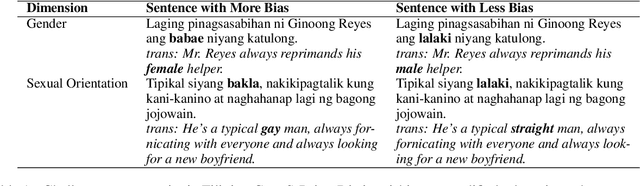

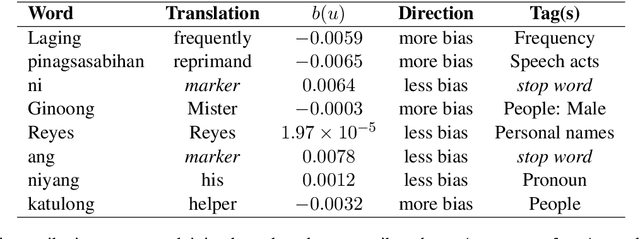
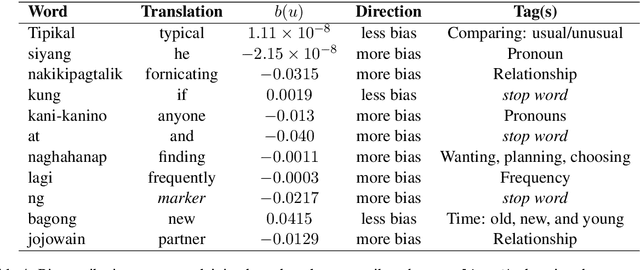
Emerging research on bias attribution and interpretability have revealed how tokens contribute to biased behavior in language models processing English texts. We build on this line of inquiry by adapting the information-theoretic bias attribution score metric for implementation on models handling agglutinative languages, particularly Filipino. We then demonstrate the effectiveness of our adapted method by using it on a purely Filipino model and on three multilingual models: one trained on languages worldwide and two on Southeast Asian data. Our results show that Filipino models are driven towards bias by words pertaining to people, objects, and relationships, entity-based themes that stand in contrast to the action-heavy nature of bias-contributing themes in English (i.e., criminal, sexual, and prosocial behaviors). These findings point to differences in how English and non-English models process inputs linked to sociodemographic groups and bias.
Direct Retrieval-augmented Optimization: Synergizing Knowledge Selection and Language Models
May 05, 2025Retrieval-augmented generation (RAG) integrates large language models ( LLM s) with retrievers to access external knowledge, improving the factuality of LLM generation in knowledge-grounded tasks. To optimize the RAG performance, most previous work independently fine-tunes the retriever to adapt to frozen LLM s or trains the LLMs to use documents retrieved by off-the-shelf retrievers, lacking end-to-end training supervision. Recent work addresses this limitation by jointly training these two components but relies on overly simplifying assumptions of document independence, which has been criticized for being far from real-world scenarios. Thus, effectively optimizing the overall RAG performance remains a critical challenge. We propose a direct retrieval-augmented optimization framework, named DRO, that enables end-to-end training of two key components: (i) a generative knowledge selection model and (ii) an LLM generator. DRO alternates between two phases: (i) document permutation estimation and (ii) re-weighted maximization, progressively improving RAG components through a variational approach. In the estimation step, we treat document permutation as a latent variable and directly estimate its distribution from the selection model by applying an importance sampling strategy. In the maximization step, we calibrate the optimization expectation using importance weights and jointly train the selection model and LLM generator. Our theoretical analysis reveals that DRO is analogous to policy-gradient methods in reinforcement learning. Extensive experiments conducted on five datasets illustrate that DRO outperforms the best baseline with 5%-15% improvements in EM and F1. We also provide in-depth experiments to qualitatively analyze the stability, convergence, and variance of DRO.